Select a species to read its profile.
- Andorian
- Arbazan
- Ardana
- Arkarian
- Aurelian
- Bajoran
- Benzite
- Betazoid
- Bolian
- Caitian
- Cardassian
- Deltan
- Denobulan
- Edosian
- Efrosian
- Ferengi
- Grazerite
- Haliian
- Human
- Klingon
- Ktarian
- Orion
- Rigellian Chelon
- Rigellian Jelna
- Risian
- Romulan
- Tellarite
- Trill
- Vulcan
- Zakdorn
- Zaranite
Andorian
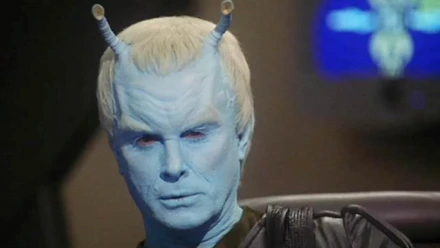
An aggressive, passionate people from the frozen moon Andoria, the Andorians have been part of the United Federation of Planets since its foundation, having been firm allies of Humanity for several years beforehand. Their blue skin, pale hair, and antennae give them a distinctive appearance, and while the Andorian Imperial Guard was demobilized when the Federation was founded, they still maintain strong military traditions, and a tradition of ritualized honor-duels known as Ushaan, using razorsharp ice-mining tools.
Extended background
Andorians are somewhat akin to the Klingons, or the Vikings, from Earth's history. They are aggressive, and honorable, often living for the fight. They have their differences, however. Central to Andorian society is the concept of the duel. These duels are often formalized affairs, though they are not witnessed save by the participants, a group of three judges, and a pair of specially trained actors, who record the duel in a specialized notation, and can play it for others a year after the duel. The duels are used to resolve matters of honor, and are a outlet for Andorian aggresiveness, which threatened the Andorians with extinction hundreds of years ago.
Another central Andorian concept is devotion to one's family, both immediate and extended (which are formed into clans, known as Keths (singular Keth)). Spouses are considered more important than children, as throughout the annals of history, children often died before reaching maturity. Andorian marriages are an oddity, as they marry in fours. Instead of boy falls for girl, girl falls for boy, and they marry, it's somewhat different. The boy falls for the girl and vice versa, then, when they decide to marry, they find another couple who they love as much as each other, and the four marry. In some of the varied Andorian religions, the proper number is six, and this is considered legal, if somewhat unorthodox.
The key to remember when roleplaying Andorians is an overwhelming passion for everything they do. Other considerations are their aggressiveness, as well as their honor. Insults to one's honor are not, as it is with Klingons, an invitation to an all out brawl, but an invitation to duel. Andorians generally respect the military forces of the Galaxy, and accord a level of respect to military heroes akin to those 20th century humans accorded pop icons and movie stars. They rely not only on Starfleet, but also on the Andorian Defense Force, for defense from hostile powers. The ADF is among the largest non-Starfleet military in the Federation, and primarily concerns itself with anti-piracy operations these days, though. A few other traits many Andorians, though not all, tend to share are a fascination with history, a fascination with Vulcans, a fondness for the natural state of things (Andorian colonies are almost never terraformed), and few nudity taboos (Andorian lodging is often communal, with no private rooms). This also means that nudity has almost none of the erotic connotations that it posses in most cultures, and a severe dislike of large bodies of water.
Arbazan
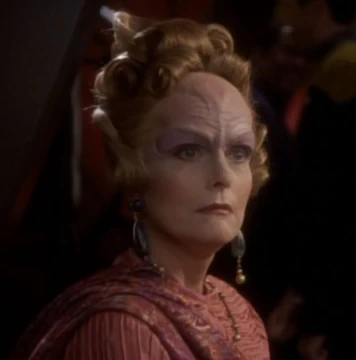
The stoic Arbazan take great pride in their long-standing Federation membership and early contact with Starfleet. Many consider them among the Federation’s founding members. Like many humanoid species within the Federation, the Arbazan are physically similar to Humans, though the forward portion of their skulls have slightly raised plates that reinforce their brows. The Arbazan are known for their conservative values, infallible self-confidence, and devotion to social protocol. Some, however, find the cultural focus on proper social etiquette to be stifling, and rebellious young Arbazan can often be found at Starfleet Academy pursuing security or ship operation roles.
Ardana
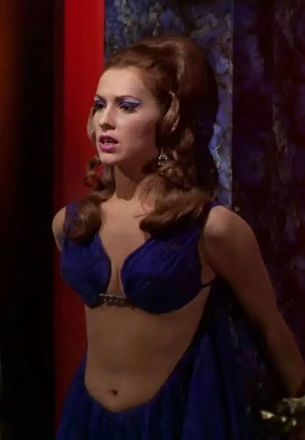
Ardanan citizens have a long history of societal division. The two castes that still hold sway over an Ardanian's potential are the city-dwellers of the floating city, Stratos, and the surface dwelling Troglytes. The two groups are anatomically alike. Exposure to zenite in the mines impairs the Troglytes’ higher brain functions, making protective breathing apparatus essential and mandatory under Federation industrial requirements. In contrast the beautiful City of Stratos, floating in the lower atmosphere of Ardana, is home to a people entirely devoted to art, government and culture.
Arkarian
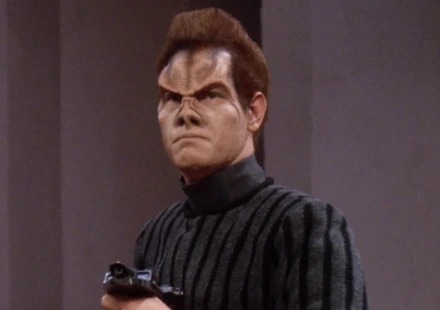
Arkarians are native to the Class-M world of Arkaria, home to the Remmler Array -- an orbital facility that removes built-up baryon particles (a by-product of warp travel) -- and Arkaria Base. Arkaria is a member world of the Federation and Arkarians serve throughout Starfleet and other Federation organizations. Arkaria is known for its abnormal weather patterns, resulting in extremely colorful sunrises and sunsets of every shade of green, pink, and purple as well as higher-than-normal average temperatures. The nature trails that run throughout the sweeping plains located near Arkaria Base are a common attraction for those visiting the Array or Base, especially for those wanting to see the nesting sites for horn fowls. Arkarians are physically very similar to Humans and other humanoid species -- save for distinctive brow and nasal ridges. Their society has recently begun to shift away from its traditional authoritarian nobility toward the more common egalitarian systems found throughout the Federation. This is largely believed to be due to the increasing interactions between Arkarians and other Federation member worlds, though a conservative minority continues to maintain their noble holdings and social expectations.
Aurelian
One of the few avian species to be represented within the Federation, the Aurelians are renowned for their study of history and service within the Federation Science Council. While not unheard of, there are a few Aurelians serving in Starfleet, and those that do most commonly work as science officers. Aurelians dislike enclosed spaces and many suffer from a mild form of claustrophobia, which makes long-term service aboard a starship that much more difficult. Most Aurelians that pursue a career in Starfleet request assignments at planetary installations, allowing them to spend their off-duty time outdoors. Their homeworld of Aurelia is an abnormally large Class-M planet covered by large expanses of scrub lands and mild deserts. Aurelians on Aurelia make their homes in natural mesa formations. Aurelians maintain ties with Humanity that reach back to early deep space exploration, and their Federation membership dates from several decades after its formation.
Bajoran

A spiritual, dauntless people from the planet Bajor, the Bajorans have lost much after decades of occupation by the Cardassian Union. Many Bajorans were scattered across the Alpha Quadrant during the occupation, while those who remained on Bajor often acted as insurgents or toiled in labor camps under Cardassian rule. The occupation ended a few years ago, but the scars it left will take generations to heal. Bajor is not a member of the Federation, but many Bajorans scattered by the diaspora have found their way into Starfleet. Bajoran culture places a strong belief in the Prophets, celestial beings who are said to have watched over Bajor for millennia; modern religious doctrine states that the Bajoran Wormhole is the Prophets Celestial Temple.
Extended background
The Bajoran species are similar in appearance to most Humanoids in terms of average height, weight as well as build. Their skin color as well as hair and eye color variations match those of Humans. The most distinctive feature among the Bajoran people are their horizontal nose ridges which is the only notable physical feature that is noted in their appearance.
Bajoran naming customs place the family name first, and the given name to follow.
Bajorans are a highly religious people with their faith revolving around the dimensional entities that occupy the Celestial Temple, known a the Bajoran wormhole to others, who are known as the Prophets. The people of Bajor consider the Prophets gods and believe that they watch over them and communicate through prophecies interpreted from comets and the eight mysterious Tears of the Prophets. Scientists describe the Prophets as alien entities that reside within a wormhole. This scientific approach has little effect on the bulk of Bajoran society.
This meant that Bajoran religion engulfed their entire society with even those that rejected the faith being able to quote from the Sacred Texts. In addition to this, most Bajorans believe that they possess a lifeforce known as a Pagh with some believing that those who follow the paths dictated in the Texts will possess pure pagh. In contrast, those who turn away from the Prophets and live selfish lives have their pagh become dark as well as corrupt. Its known that some Bajoran mystics are capable of sensing the pagh of a person by close contact with the person.
Benzite
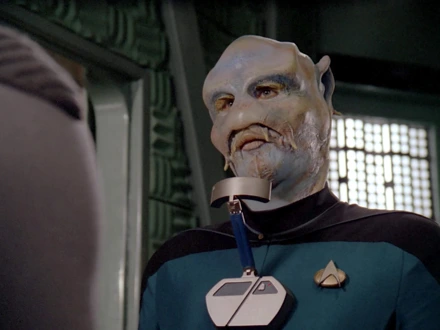
Benzite physiology gives this species' skin a hairless blue-to-green complexion. The Benzite skull has a thick protrusion that extends over the brow and nose, with two facial tendrils above the lip. Benzites in Starfleet can breathe a standard nitrogen/oxygen atmosphere without the breathing apparatus required before 2370. This adaptation is rumored to result from genetic engineering, though reports remain unconfirmed. Highly meticulous, a Benzite Starfleet officer is a valuable resource when it comes to exploration and investigation.
Betazoid
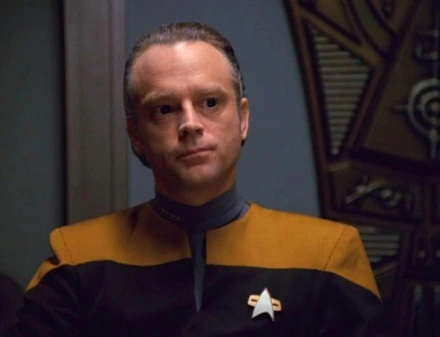
The peaceful Betazoid people hail from the idyllic, verdant world Betazed. The world is a valued member of the Federation, and its people can be found across Federation space, including Starfleet. Betazoids appear almost identical to Humans, but differ in one major way: they are naturally telepathic, developing mental abilities during adolescence. The potency of this ability varies between individuals, but it has resulted in a culture where honesty and directness are fundamental: it is difficult to keep secrets when everyone around you can read minds.
Extended background
The Betazoids are a telepathic humanoid race originating from the planet Betazed. They have enjoyed a relatively untroubled history for the last several centuries. This peaceful period in their history came to a halt in 2374, when the Dominion invaded and occupied the planet. This occupation ceased at the end of the Dominion War, but some of its affects can still be seen and felt 11 years later.
Bolian
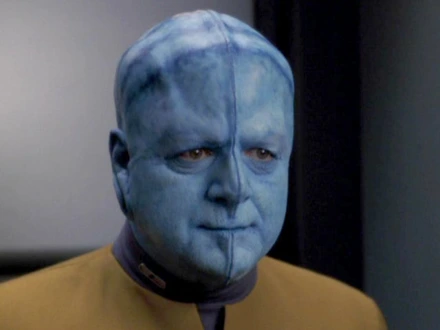
From the planet Bolarus IX, Bolians are well known for their hospitality and outgoing personalities. Identified by a cartilaginous ridge that extends down their head, vertically, down the center of the face to the chest, with skin color ranging from light blues, to dark greens and muted purples with darker banding across the head. They are predominantly bald, though some females are known to have hair on their heads. Bolian marriages have more than two partners, of both sexes, but procreation with other species isn't all that common, given the Bolians' incompatibility with others. Humans, in particular, have noted several side effects of inter-species relations, including nausea, fatigue, and inflammation.
Caitian
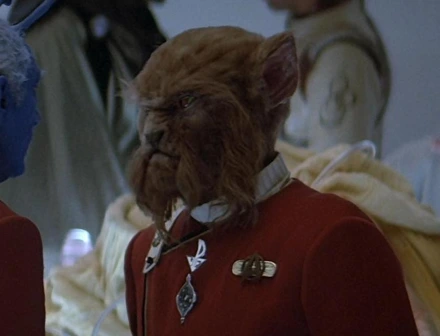
The Caitian are a bipedal felinoid species with a strong history of service within Starfleet. Their homeworld of Cait is a pleasant Class-M planet with extensive grasslands that support sprawling city complexes that integrate seamlessly into the environment, for which the Caitians have great respect. While known to be extremely effective and proud warriors, the Caitian culture holds artistic and philosophical endeavors in extremely high regard. Following their acceptance into the Federation in the late 22nd Century, Caitians have come to serve at all levels of Starfleet -- to include high-ranking flag officers as well as often being elected to serve on the Federation Council. On average, Caitians tend to be slightly smaller than most other humanoid species. While this often results in Caitians being somewhat weaker than Humans, they more than make up for this in their balance, agility, and dexterity. Caitians are one of the few species actively serving within Starfleet that possess a tail -- which requires alterations to standard Starfleet uniforms.
Cardassian
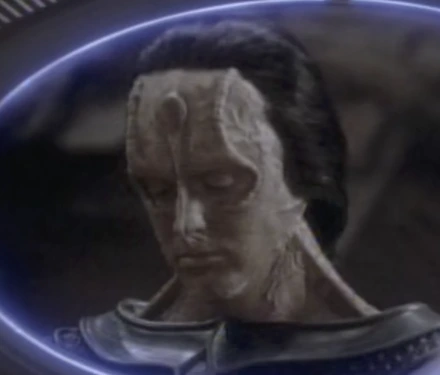
There are few species as disliked or mistrusted as Cardassians. While they generate art, music, and poetry to match any other species -- Cardassians are known instead for their devotion to the State, aggressive military tactics, and absolute faith in their own superiority. Advancement in Cardassian society is driven by capability and demonstrated success, resulting in an upper class of cunning and strategic individuals who expect complete devotion of their subordinates and families. While they may not be as technologically capable as the Federation, the ruthless efficiency of the Cardassian government and military has resulted in making them evenly matched with Starfleet during engagements over the last few decades. A suspicious people, the Cardassians boast one of the most effective intelligence agencies in the Alpha Quadrant, rivaling even the Romulan Tal Shiar in its capabilities. To Cardassians, this suspicion is often equated to wisdom, and venerated elders ensure this value is passed on to subsequent generations. While it may seem abhorrent to other powers in the quadrant, Cardassians feel that any action is justifiable if it results in the desired outcome -- and they have no reservations about using, extorting, and subjugating anything or anyone if it brings prosperity to the Cardassian Union.
Deltan

These humanoids from the Delta system differ in appearance only slightly from Humans, with very little hair across their bodies, aside from eye brows and lashes. As a telepathic and empathic species, the Deltans rank themselves alongside the Vulcans and Betazoids as able to read and communicate via thoughts and feelings. Indeed, some Deltan genealogists have theorized Betazoids are a distant cousin species.
With some of the most potent pheromones the Federation has ever encountered, many other species find the Deltans very sexually appealing. The vast majority of Deltans in Starfleet, therefore, take an oath of celibacy, ensuring their sexuality is not a distraction to their colleagues. By all accounts this is a good thing, as the Deltan act of intimacy involves not only their bodies but also their telepathic minds, possibly endangering the mental health of other species.
Extended background
Deltans are a humanoid species from the Federation planet Delta IV. They are often identified by their bald scalps. They do have a pain relieving ability that is manifested on physical contact, however it only serves to reduce pain and does not actually heal injuries. Because of their high sexuality, Deltans have to swear an Oth of Celibacy upon entering into service for Starfleet, as a promise not to take advantage of any fellow crewmembers.
Denobulan
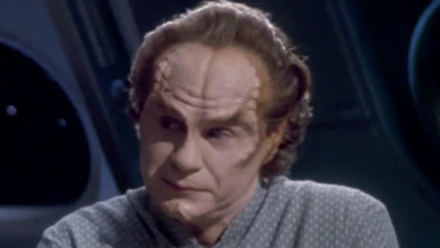
Hailing from the planet Denobula, Denobulans are a gregarious, inquisitive people who have been allies of Humanity since the 2130s. Denobula’s Federation membership dates from shortly after its founding. Denobulans are a sociable people, with distinctive expressive features, who are used to living in close, communal conditions, and whose extended family groups are large and complex. A Denobulan may have several spouses, each of whom may have several partners of their own, and dozens of children between them. Culturally, they are intellectually curious, perceptive, and interested in a wide range of philosophies, though their scholarly nature, large families, and gregarious nature mean that relatively few of them venture far from their homeworld.
Edosian
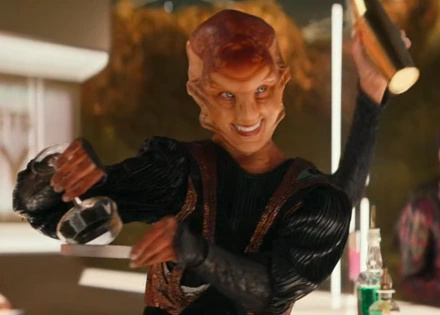
Edosians are a tripedal species with three arms and three legs. While not a member of the Federation, the Edosians have a long-standing, loose alliance with the Federation since their earliest contact. It is rare, though not unknown, for Edosians to serve in Starfleet. Edosian culture tends toward inner reflection and a meticulousness with historical records. Genealogy has a much larger focus than in many other cultures, and Edosians are able to trace their individual family lines back thousands of years. Being a race that lives longer than even Vulcans, an Edosian may spend decades focused on a particular area of study before moving on to a new interest. Interesting to exobiologists, with practice, an Edosian becomes capable of allocating sections of their brain to each arm, operating independently with nearly fully focus and capability.
Efrosian
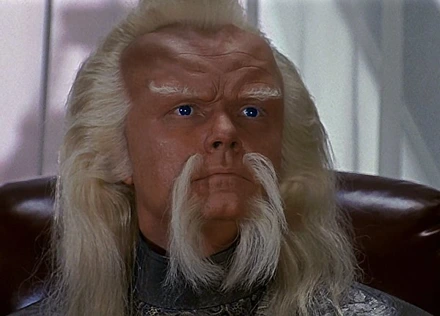
Hailing from the planet Efros Delta, Efrosians are renowned musicians and historians. Their society is dedicated to oral teaching, most notably in the form of a musical language that all Efrosian children are taught in some form or another. They are also excellent navigators and are often sought out as helm and navigation officers, as well as translators thanks to being natural linguists and communications experts. While their cranial ridges bear some similarity to Klingon physiology (though less pronounced), a male's hair is almost always white from birth while females exhibit darker colors. Males grow long moustaches and both male and female Efrosians grow their hair out down their backs.
Ferengi
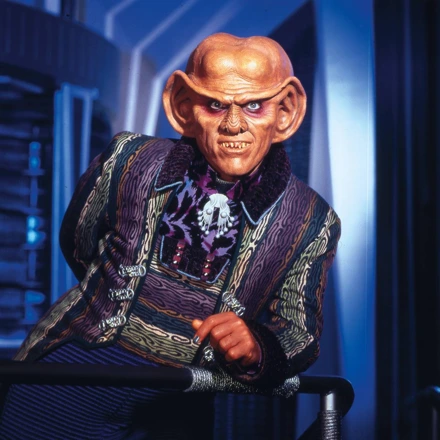
While Ferengi have ventured through the stars in search of profit and advantageous business arrangements, official first contact with the Federation did not occur until 2364. In the following decade, Ferengi can be found nearly anywhere there is profit to made. Nearly all of Ferengi culture, government, and beliefs are based around the acquisition and retention of wealth -- earning them a reputation as greedy, duplicitous, and conniving merchants and con-men. While some Ferengi are not obsessed with wealth or self-promotion, they are few and far between and are looked down upon by other Ferengi. With a society devoted to business and trade, there is little central government outside of business and regulatory functions. The Ferengi Alliance is, in reality, a collection of corporate and private businesses and their territorial holdings. The Ferengi Alliance maintains no standing military, relying on privateers and alliances with other species. Ferengi culture is extremely chauvinistic, with females considered a form of property, forbidden to engage in business, own property, receive inheritance, or even wear clothes. That does not, however, stop ambitious and dedicated Ferengi women, and given the current state of galactic affairs, the time for change may be coming.
Grazerite
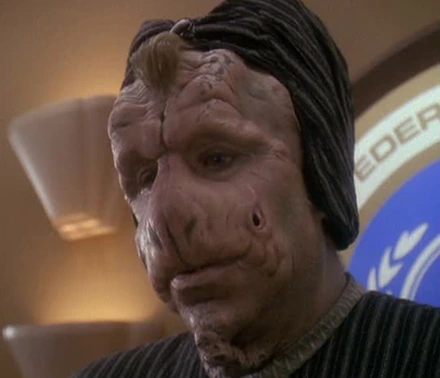
The Grazerite are a peaceful people whose homeworld, Grazer, is one of the harsher examples of the far ends of the planetary M classification. The three main continents are predominately covered by extensive mountain ranges that reach as far as 10 kilometers above 'sea level.' The Grazerites' evolutionary development has incorporated not only traditional humanoid traits -- but also those of bovidae -- giving them goat like physical features. Grazerites are a peaceful people with a natural sense of curiosity. Grazerites have a deep dislike of conflict and actively avoid it if possible. Grazerite officers in Starfleet pursue careers in most fields -- but it is nearly unheard of to see them serving as tactical or security officers. In Grazerite society, it is considered impolite (boarding on indecent) to leave one's horns and hands uncovered -- and thus Grazerites are usually seen with gloves and a headwrap.
Haliian
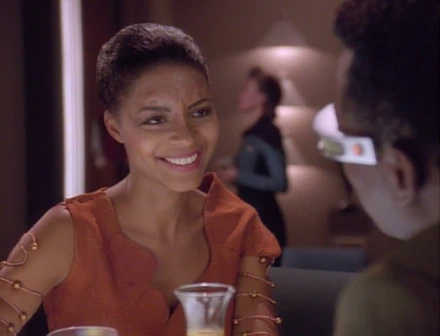
Haliians are native to the Federation world of Halii -- renowned for its crystal formations and beautiful waterfalls. As one of the few telepathic species in the Federation, the Haliians share many of the same social nuances of other telepathic or empathic species, such as Betazoids. Haliians often find it hard to truly connect with non-Haliians, and this has the unfortunate effect of limiting their interactions with other Federation species. Due to the nature of their telepathic abilities, Haliians are either far more prone to physical contact during social encounters or avoid it entirely depending on individual in question. Haliians also share a deep fondness for holidays -- of which they have many -- which almost always involve music.
Human
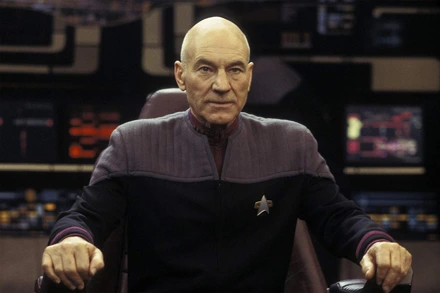
Originating on the planet Earth in the Sol system, Humans are a resilient, diverse, and adaptable species, who developed from fractious, warring nations on the brink of mutual annihilation to a united, peaceful society in less than a century, and managed to forge alliances between former enemies within a century of achieving interstellar space flight. Earth is a founder and pivotal member of the United Federation of Planets, and many of the Federations institutions can be found on Earth. Humans often exhibit a dichotomy in their nature being both driven to strong emotion and careful reason and while they have largely grown beyond their warlike and divisive past, their drive and capacity for aggression are as much a part of their success as their curiosity and analytical minds.
Extended background
Humans are one of the easiest species to roleplay, but a number of common mistakes pop up when playing one in the Star Trek universe. The foremost of these is remembering that humanity has undergone a massive shift in consience. First Contact sparked a drive to explore instead of war with each other, when the long-supressed urge to reach for the stars was finally made possible. Hatred, discrimination, and ignorance have all but disappeared in the centuries since Zefram Cochrane's historic flight. No longer does the color of one's skin, or gender, or even point of origin matter.
Another common trend is for all humans to be from Earth. To quote James T Kirk, “We're on a thousand planets and spreading out.” That's a lot of planets that a human could come from, and more have been colonized since the quote. Humanity is spread across the galaxy, and it's always seek more places to claim. Colonies often differ from the homeworld, as people leave major worlds for various reasons. Some leave due to ideological differences, some for the chance to claim a planet for their own, and some for the challenge of building a civilization from almost nothing. The earliest human colonies were on Mars, Alpha Centauri, and a handful of nearby planets. And yet, with all these options, people still choose to come from Earth.
Another common trend is to play them as if humans in the 24th century are as warlike as we in the early 21st. As mentioned earlier, human society has mostly outgrown the need for war, and resources are plentiful. Ideological differences usually don't pose a problem, as humans are more open-minded than they are now, and if tension does grow almost unbearable, the 'splinter' group often leaves to form a colony of it's own.
Lastly, rather an opposite of the last point, many people overcompensate for the fading importance of war, and are purely peacefulness. Hostility is fading, but not gone, and humanity still recognizes that, in some circumstances, correctly applied force is still the best solution. It simply alters the application of such force from overwhelming force and all-out war to surgical strikes, and commando raids, designed to cripple the enemy. Federation units dedicated to combat are usually trained at the special-forces level of today, and serve roles similar to that of the SEALs, US Rangers, and SAS.
Klingon
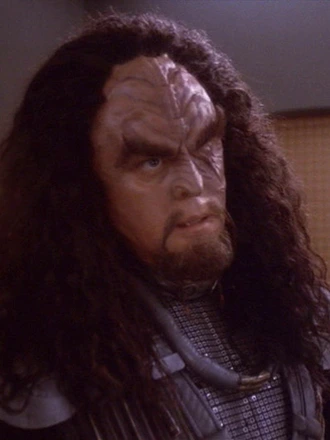
With its capital at Qo'noS, the Klingon Empire is almost as large as the Federation, and larger than the Romulan Empire. Distinguishable by the sagittal crest over their foreheads and crowns, Klingons are taller and stronger than most humanoid species, something that helps enhance their reputation as warriors. The hardy Klingons have been both allies and enemies throughout their years of contact with the Federation. Now, as staunch allies, this proud people have begun to exchange officers with Starfleet. Not only that but Worf, son of Mogh, created a precedent as the first Klingon to graduate of Starfleet Academy. This has brought more applications from Klingons, especially those of mixed heritage who don't feel at ease in the Klingon Empire. Klingons embody pride and honor above all. Many dedicate their lives to the warrior ethos for the honor of house and family.
Ktarian
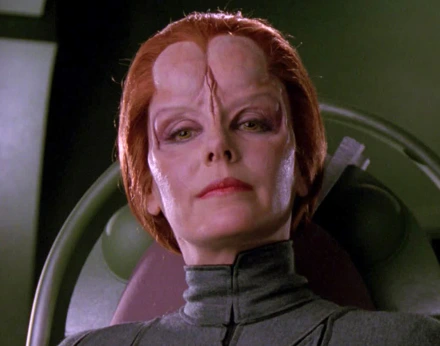
The Ktarians are a physically diverse species native to the Federation world of Ktaris. They are a common sight throughout Federation space and are one of the many species that maintains its own fleet of vessels -- both merchant and military. The Ktarian fleet is considered to be a reserve force, and can be transferred to the command of Starfleet during times of great need. Unlike most Federation species, the Ktarians are comprised of two separate species that evolved together on Ktaris -- one whose brows are bisected into two hemispheres and the other with bone ridges along the center of the forehead. Intermarriage among these two species has resulted in both carrying the traits of the other. Predicting which traits will manifest in offspring is extremely difficult, especially when Ktarians mate with other species. Rumors circulate that the Miradorn are an offshoot of Ktarians, but the Miradorns' reclusive nature makes this difficult to confirm.
Orion
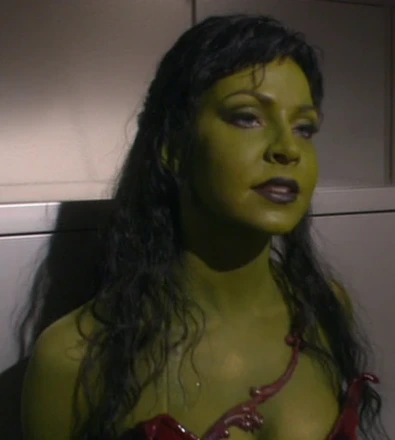
Orions have a well-earned reputation for finding advantages, and as a people they are skilled at assessing risks or evaluating odds. Somewhat arrogant by nature, their egocentricity makes them confident and proud of themselves and their skills. Officially, Orion systems are ruled by a single governmentthat has long maintained neutrality in galactic politics. However, members of the species are infamous for their involvement in many criminal endeavors, including piracy, slavery, and the notorious Orion Syndicate. Materialism is the predominant force in Orion culture, driven by their principle philosophy that value given has to equal the value received. As a result of this philosophy, Orions are hedonistic, living as well as they can within their means and aiming to enjoy life as much as they can afford. They are driven to seize opportunities that lead to increased profit, comfort, or pleasure. While they value physical objects, Orions have little sentimentality: everything gained has to serve some purpose, whether for personal enrichment, the sake of one's leader, or just simple revenge.
Extended background
The Orions are a warp capable humanoid species from the Alpha Quadrant. Their homeworld is the planet Orion, in the Orion system.
They are known for their distinctive green or blue skin. Orion males are on average bald, taller and more muscular than the average human. The females of the Orion species are described as very animalistic in nature, known for their extreme carnal appetites and their innate seduction skills. A human male can rarely resist the alluring dance of an Orion slave girl.
Before 2270, the Orions tried to maintain an air of neutrality in and around Federation space. This was done mainly as a guise to cover their more shady operations. This position of neutrality comes before ship and crew, all unsuccessful Orion missions end in suicide.
In spite of the Orion society's rich cultural history and “official” stance of neutrality, the truth is that of a dark side to the culture in the form of trafficking of forced labor through the Orion slave markets, most especially the Orion slave girls.
The main group that controls activities is known as the Orion Syndicate, which is made up of traders, pirates and smugglers. The Syndicate is well known for its many illegal operations including extortion, theft, raids, kidnappings and assassinations.
Rigellian Chelon
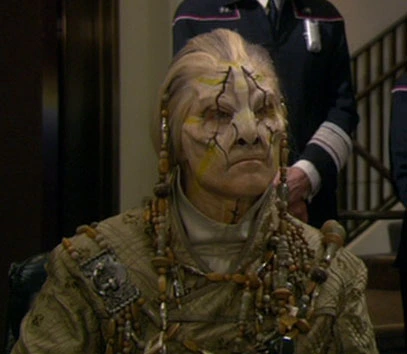
Chelons are a hardy race, sharing their home solar system of Rigel with Rigellian Jelna. They are descendants of sabertoothed turtles and, though bipedal, they have retained their ancestral beaks, claws and hard shells. Chelons are androgynous and take on masculine or feminine societal roles at varying points in their lives, reproducing like most reptilians by laying eggs and fertilizing those eggs. Some traditionalists within Chelon society maintain a neutral gender, and refuse to take on male or female roles.
Rigellian Jelna
The Jelna, like the Chelon, are natives of the Rigel system and come from Rigel V. A diligent and hard-working species, the Jelna take pride in their pioneering role in Rigellian space flight, commerce, and systemwide government. They favor peaceful cooperation and democratic representation for all Rigellian species on the Governing Board and the Rigellian Trade Commission. The humanoid Jelnas have four genders: two male and two female genders. Male and female exosexes contain an additional Z chromosome, and they outnumber the endosexes 2 to 1. Exosexes are the more resilient and physically adept members of the species, while endosexes are more comparable to the male and female sexes typically found in other humanoid species.
Risian

Risians are known throughout the Federation for their hospitality, ceremonial traditions, and open attitude to sexuality. Their homeworld, Risa, is a popular pleasure planet where environmental controls keep fierce storms and tectonic instability in check. Tradition and ceremony are central to Risian society. Those seeking partners display a ceremonial icon called a horga’hn to invite participation in the sexual rite of jamaharon.
Romulan
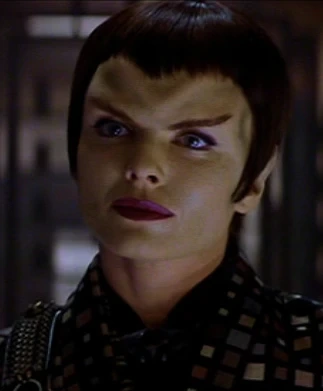
Romulans are a proud people who share their origins with the Vulcans. In 2386, Praetor Gell Kamemor leads an Empire rebuilding after years of upheaval and the Borg invasion. Her government is pursuing closer diplomatic ties with the Federation, while Spock’s Reunification movement operates openly and the Remans have gained a measure of autonomy.
Extended background
The Romulan Star Empire is led by Praetor Gell Kamemor. After years of civil war, assassinations, and shadow wars, her government is focused on stabilizing the Empire from within and rebuilding its economy, infrastructure, and fleet.
Government and diplomacy
Kamemor is a pragmatic reformer. While the Empire remains a member of the Typhon Pact, she has moved away from military aggression against the Federation, opening genuine diplomatic channels and intelligence-sharing agreements with Starfleet. Hardliners in the military and the fractured Tal Shiar resent these policies and regard her peace overtures as weakness, though her grip on the Senate remains secure.
Society and culture
Ambassador Spock’s Reunification movement now operates openly. Vulcan and Romulan citizens debate their shared history, philosophy, and future on Romulan soil.
Shinzon’s coup, Donatra’s secession, and the losses of the Borg invasion have left the Empire concentrating on recovery. Rebuilding worlds and a depleted fleet takes precedence over conquering its neighbors.
Following years of rebellion and political upheaval, the Remans have gained a measure of recognized autonomy and representation. Deep cultural distrust between Romulans and Remans persists.
History
Romulans are an offshoot of the Vulcans, having left Vulcan after a fundamental disagreement with Surak's philosophies. They are a proud warrior race who are extremely suspicious of outsiders.
Origins
On Vulcan
In Surak's time (somewhere in the 4th century AD, Earth calendar), Vulcan was invaded by Etoshan pirates. These pirates initially came with messages of peace, only to kidnap or slaughter large numbers of Vulcan citizens. Up until that point, Vulcan was still a fractured planet of many families and clans. Under threat from the Etoshans, Vulcan united to drive off these invaders.
After the Etoshans were gone, Surak argued that peace and logic was still a possibility. One of his students, S'task, countered with the evidence that the universe was hostile and should be met with force. Neither side wished to destroy Vulcan itself over this difference of opinion, so it was gradually decided by all that S'task and his followers should leave Vulcan and seek a new homeworld.
In a process that could have bankrupted Vulcan, 16 huge interstellar ships were designed and built over a period of more than two decades. Each ship was designed to carry a passenger compliment of approximately five thousand people. Although they had no warp drives, they could get up to near-light speed with the use of deadly (for the person doing it) psionic techniques.
Starting almost from scratch, and while waiting for their ships to be completed, these soon-to-be exiles created an entirely new language and came to call themselves “the declared” or, in their language, Rihannsu. Over time, they also developed their own Romulan religion. Not everyone who embarked upon these generation ships actually wanted to go. Some were pressured into it by others, for various reasons. Traces of this, especially resentment between various families and clans, persist to this day.
The Journey
The launch date is officially known by Romulans as “the Sundering”. The date is sometimes celebrated and sometimes mourned, though it is not an official holiday.
At the beginning of the trip, multiple failures and malfunctions plagued the vessels. There were several crop failures and mild famines, though few people died of anything rare maintenance accidents. Seven ships were lost in the event horizon of a black hole. Two more ships were lost to psychic “vampires” at the planet Iruh. Another two ships were lost at separate times due to unreparable drive system malfunction. Plagues, perhaps mutated by the drive radiation, began to kill off fifty to seventy percent of the passengers on the remaining ships.
Of the sixteen ships that left Vulcan, only five survived to reach ch'Rihan and ch'Havran. Although ch'Havran, or Remus, was poorer in resources than ch'Rihan, or Romulus, both planets were infinitely richer than the Vulcan that they had left behind.
After Planetfall
Despite the unprecedented riches, there were still squabbles among the eighteen thousand surviving Romulans over who would get the best pieces of land. Some did not want to leave, electing to stay aboard ship as long as possible. This group became known as the Ship Clans. The rest held a lottery, which even today some claim was rigged, to decide who went where. What is known is that most of the reluctant travelers ended up on the worst parts of ch'Havran and not on the lush world of ch'Rihan.
Population Building
Due to low number of survivors, drastic measures were taken to ensure that the Romulan people wouldn't die out. Although no law was ever written, even the poorest of women were encouraged to have no fewer than four children. Large families were the norm, with some of the more affluent Houses seeing it as their duty to “adopt” those who could not afford families of their own. Over time, these adopted members grew to be the servant and slave class of the wealthier Houses.
Because of the small gene pool available, genetic manipulation and IVF treatments were bought by the wealthiest in order to increase their numbers and avoid their offspring having any inheritable disabilities. Modern Romulans have a reputation for destroying any infant that is obviously imperfect, but they like to forget that this wasn't always so and most do not even know their own history.
For a time, it was “fashionable” to exile political dissidents and otherwise undesirable citizens to the most hostile, inhospitable, and otherwise uninhabited locations on the Eastern Continent of ch'Havran. Deformed or otherwise supposedly weak children were also sent to these places, to be cared for by the political prisoners and their overseers. This was not completely unlike the nearly-forgotten Earth custom of “exposing” an unwanted infant and leaving it to die. Those who survived this treatment were still considered less than full Romulans, but had proven their worth.
When precious stones like rubies and dilithium were discovered under these hostile reaches, these less-than-Romulans were the perfect choice to mine the ore. Over time, exposure to dilithium radiation, hard work, lack of sunlight and so forth mutated these beings into the race known today as Remans.
Wars
Even while trying to build their numbers, the Romulans were busily and cheerfully engaged in killing each other off. Of the eighteen thousand who arrived at the homeworlds, five to six thousand of those died in the first decade after planetfall. Fresh water was often a contested resource, although there was no shortage of lakes and streams for the Romulans to use. Each powerful House reckoned power and wealth slightly differently and they were only too glad to fight for an even better position.
Modern Romulan warfare is usually focused on yikh, or outsiders, rather than on each other. However, power struggles and quiet assassinations are still extremely common among the upper classes.
Modern Romulans
Federation Contact
After centuries of isolation, the Romulans had nearly forgotten that there were aliens in the universe. Vulcan was a distant memory. The Great Ships had been slowly abandoned by the Ship Clans and, eventually, fell from orbit. Only small interplanetary shuttles remained, to ferry goods between the two worlds.
The memory of the rest of the galaxy was reawakened around fifteen hundred years after planetfall, when the Federation ship USS Carrizal arrived in the system. Upon arrival, it began broadcasting messages nearly identical to the ones the Etoshans had used. Obviously, the only response was to hastily build ships for a brutal, savage and unrelenting interstellar war.
Federation/Romulan War
Although the Federation had better technology, Romulans had an advantage of numbers and sheer tenacity. Captured Federation ships helped provide new technology, such as warp drive, to the Romulans. Although neither side was able to overwhelm the other, the Romulan tactics eventually forced the Federation to sue for peace.
Post-war
Following the war, the Romulans entered an age of expansion. Although the Neutral Zone Treaty had established a boundary on the Federation side, there were plenty of star systems on the Romulan side of the zone to conquer. Although native populations were exceedingly rare in their section of space, those that were found were quickly subjugated and forced to serve the Romulan people. Uninhabited planets were made inhabitable and colonists were shipped in.
This expansionist period and the lack of serious infighting saw the Romulan population nearly tripled in a matter of just a couple decades. During this period, contact was made with the Klingons. Although distrustful, both empires initially saw a kinship in the other. In exchange for not conquering Klingon border worlds, the Klingons would provide the Romulans with badly needed ships. Or so the Romulans claim. In the end, the tentative treaty crumbled and left behind only an uneasy wariness.
Romulan Empire
Although the Romulan Star Empire had not existed when the treaty with the Federation was signed, such an entity was in place by the time they developed the cloaking device. Various machinations were tried, the most audacious of which resulted in the First Romulan Civil War. After being thwarted by Kirk, Picard, and other Starfleet captains, the Romulans finally agreed to the signing of the Treaty of Algeron.
Dominion War
During the Dominion War, the Romulans somewhat reluctantly sided with the Federation. Although siding with their sworn enemy was considered to be a poor choice, even the most traditional realized that defeat and destruction at the hands of the Dominion would be much worse. With the end of the Dominion war, this alliance was broken and the Romulans once again viewed the Federation with hostility and suspicion.
Tellarite
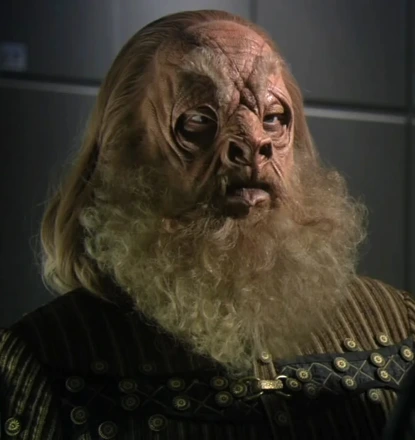
The stout, hirsute Tellarite species comes from Tellar Prime, a temperate planet in the Alpha Quadrant. Theirs is a culture noted for being abrasive and argumentative, with a stubborn pride, quick tempers, and little patience. However, this is only a superficial view: while Tellarites are argumentative, it comes from a sense of intellectual honesty and rigorous skepticism. To a Tellarite, no idea, concept, or person is beyond challenge or analysis, and any notion that cannot stand up to scrutiny is an unworthy one. Tellarites revel in debates, and tend to greet one another with criticisms, complaints, and even insults; failing to respond in kind is poorly-regarded, as it displays a weakness of character and an unwillingness to confront flaws.
Extended background
Tellarites are a porcine species whose facial features are somewhat pig-like. They have black pupils set in deep eye sockets and large snouts. Their skin is pinkish-brown and coarse, and normally heavily covered with hair. They have average heights of: 1.8 meters (male) 2.2 meters (female) and a life expectancy of 87 years (male) 93 years (female). Tellarite legs end in two- toed feet with hooves, and their femur is notable for missing its of the third tochanter, and that their fibula is vestigial. Their digestive system is designed for plants, and as such they have two stomachs which utilized bacteria to break down the food before entering their single intestine. Despite this, canines are a delicacy on Tellar Prime. The Tellarite sense of smell and hearing is advanced for a humanoid, while their eyesight is sub par. Tellarites are almost always born in groups of six, as they approach puberty they developed a bristly yellow mane of hair. They reach adulthood by the age of twelve Earth years.
Trill

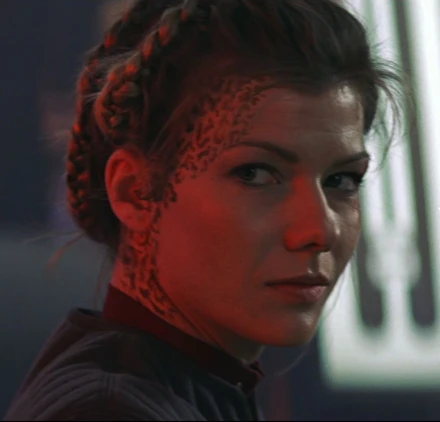
The Trill species, from their homeworld of the same name, appear almost identical to Humans, but for rows of spots running down the sides of their bodies, from head to toe. However, this superficial similarity conceals a considerable difference - the Trill are capable of bonding with a symbiotic organism known as a symbiont, creating a distinct being from the two individual creatures. The symbionts can live for many centuries, and are placed with successive hosts, carrying the memories and knowledge of previous hosts into a new joining with each new generation. This fact isnt widely known outside the Trill themselves, but it isnt a secret - it simply isnt widely discussed, and the number of joined Trill is relatively small. The Trill have been part of the Federation for well over a century, with several renowned Trill serving important roles in shaping the Federation. The Trill, as a culture, tend to be focused on intellectual pursuits first and foremost, as learning and wisdom are prized by the symbionts in their hosts.
Extended background
The Trill are a humanoid species native to the planet Trill. A small proportion of the Trill population co-exists with a sentient symbiotic organism known as a symbiont inside their bodies. The resulting joined Trill have personalities which are a synthesis of the two beings including the memories, and to some extent the personalites, of the previous hosts of the symbiont. This way, the joined being gains all the skills and occupations of the previous hosts. The fact that some Trill exist as a joined symbiotic species is widely unknown, even to Federation scientists.
Most Trills are distinguished by two rows of spots going down each side of their body, from forehead to toe. One of the main neurotransmitters in the Trill brain is isoboramine.
Joined Trill are also extremely allergic to insect bites; the biochemical connections between the host and symbiont can not tolerate the reaction caused by the insect's venom. One Trill peculiarity is that they are known for having cold hands.
The few Trill that are given a symbiont are typically joined in their early to mid-twenties. The physical process of being joined is irreversible. Once joined, the host and symbiont are dependent on each other. If the symbiont is removed the host will die, even if they are otherwise healthy.
The Trill are not a secretive species. To them, the joined nature their culture is normal and not something they would think to comment on without prompting. Indeed, joined Trill can be seen as particularly genial and many have served the Federation as distinguished ambassadors and in Starfleet.
Trill don't look for romance the way Humans do. They consider it quite a nuisance and view it as a weakness of the young. Although a Trill host may have romantic feelings on occasion, it is the symbiont's wish to live on a higher plane and to try to rise above those sorts of temptations.
Trill law forbids reassociation between subsequent hosts of joined persons who were romantically involved. Trill who are found guilty of reassociation are expelled from Trill society, and their symbionts die with their current host.
The Trill are a technologically advanced species and the Trill Science Ministry is a leading center of learning and experimentation.
On average, only 300 symbionts are available for hosting each year. Because there are many more humanoid Trill than symbionts, prospective hosts are weeded out by a demanding selection procedure, overseen by the Symbiosis Commission. The competition for the few symbionts is fierce and attracts the brightest and most highly motivated of Trill society. Often the would-be hosts excel in their chosen fields and it is not uncommon for them to hold several degrees or distinctions prior to their joining. Prospective hosts may eventually become initiates under the supervision of a field docent, a joined Trill who evaluates the prospective host's suitability for joining and makes a recommendation to the Commission. A negative recommendation usually means the initiate is cut from the joining program.
Common knowledge in Trill society dictates that only 1 in 1,000 Trill make acceptable hosts. In fact, this figure is vastly understated, and is closer to 1 in 2. The myth is perpetuated very carefully to prevent widespread competition for the few prized symbionts.
Unless the joined Trill objects, a prospective host may request a specific symbiont. If a host is weak, the personality of the symbiont will overwhelm it. The joined Trill has several tools at their disposal for dealing with various aspects of their previous hosts. The telepathic ceremony of Zhian'tara allows a current host to divest the symbiont of the personality and all the memories of a previous host, which are temporarily hosted in volunteers. The transferring process is performed and supervised by a symbiont Guardian, an unjoined Trill telepath. The ceremony creates a chance for closure by having the new host address the previous hosts directly as a means of distinguishing their voices and cementing the sense of finality of its latest transition. Similary, the Rite of Emergence can focus the voice of a single previous host among the memories of the other, allowing for a more direct converse in times of need for the current host.
The Zhian'tara ritual is roughly similar to the Vulcan fal-tor-pan ritual, since both enable the respective species to perform a synaptic pattern displacement, the transfer of what could be considered as a soul.
Vulcan
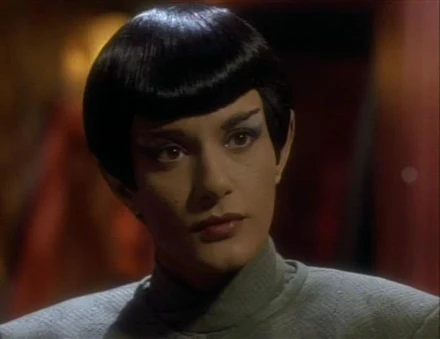
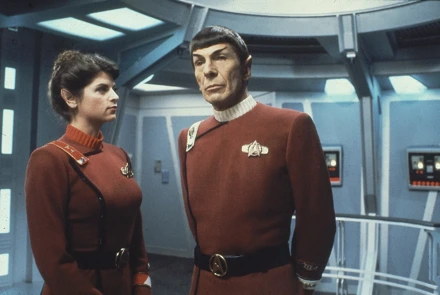
The Vulcans are a stoic, rational people. Widely claimed to be emotionless, in truth the Vulcans feel deeply and intensely, to their own detriment. Their stoicism comes from a culture of logic and self-discipline, where emotions are analyzed and dissected to rob them of their potency, so that they cannot overwhelm or control the individual. Vulcans embrace science and reason, but their lives are not purely devoted to logic: they also have a deeply philosophical side, with art and music as vital to their culture as logic. They are also an intensely private people, with many aspects of their culture - such as the rites of pon farr - which are not discussed amongst outsiders.
Extended background
The Vulcans (also known as “Vulcanians”) are a humanoid species widely known for their logical minds and stoic culture. The Vulcan homeworld is the planet Vulcan. As a civilization, Vulcans were instrumentally responsible for the founding of the United Federation of Planets.
The Vulcans were once an extremely violent and emotional people (even by Earth standards) who waged almost constant warfare on one another. They believed in a variety of gods, such as war, peace and death. As their level of technology improved, the Vulcans eventually reached a point where their violent nature threatened species extinction.
In an effort to avoid this fate, a Vulcan named Surak developed a new philosophy thereby igniting the Time of Awakening. Surak maintained that the root cause of all the problems on Vulcan lay in the uncontrolled outpouring of the people's emotions. His followers swore to live their lives by an ethical system devised by Surak and based purely on logical principles. Emotions were to be controlled and repressed.
Eventually, however, those who opposed logic left Vulcan and founded colonies elsewhere - most notably on the planet Romulus, where they founded what eventually became the Romulan Star Empire.
The official first contact between Vulcans and Humans came on April 5, 2063 when a Vulcan survey ship detected the warp flight of Zefram Cochrane's Phoenix. The Vulcans met with Cochrane at his launch site on the day following the flight.
As of the 23rd century, Vulcan had never been conquered in its collective memory. That memory goes so far back that Vulcans can't conceive of a conqueror.
Today, Vulcan remains one of the principal Federation members, and is deeply involved in all levels of that society. Their tradition of exploration has continued.
Genetically, Vulcans and Humans are similar enough that they can produce offspring without any problems.
Externally, Vulcans are generally similar to Humans, the chief exceptions being the Vulcans' notably arched and upswept eyebrows and distinguished external ear structure, the top of which tapers into a clearly defined point.
Most Vulcans have straight, glossy dark brown or, more commonly, black hair and pale skin with a very subtle greenish tinge, much as the skin of Humans of European descent has a very subtle reddish/pinkish tinge.
In contrast to their external similarities, Vulcan internal anatomy differs radically from that of Humans. For instance, their heart is where a Human's liver would normally be and beats several hundred times per minute. They also have no appendix.
Vulcan blood is copper-based and is copper- or rust-colored when deoxygenated in the veins and green when oxygenated in the arteries. Bruises and dermal abrasions therefore take on a green color.
Vulcan body chemistry uses little, if any, sodium chloride compared to that of humans. Vulcans possess a highly efficient respiratory system to extract the oxygen they need from Vulcan's thin atmosphere. They are most comfortable in high temperatures, which is natural given the hot, arid climate of their homeworld.
Vulcan hearing is very sensitive. Having evolved on a planet which is mostly desert, Vulcans have developed ways of surviving in desert conditions. For example, they can survive for several days without water and have inner eyelids which protect their eyes. Vulcans have a superior metabolism to Humans. Caffeine and sapotoxins have little effect on them. They are also capable of surviving for long durations without food or sleep. Under stress, Vulcans can do without sleep for weeks.
Zakdorn
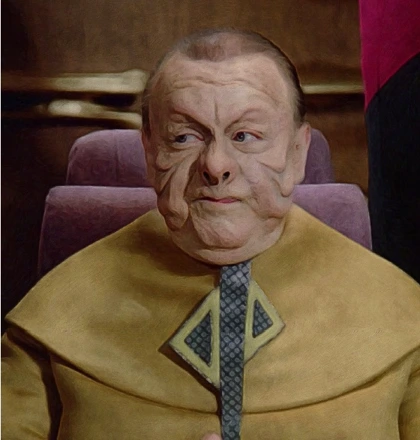
Seen as easily the best tactical minds in the Galaxy, the Zakdorn excel at complex strategic thinking. This asset has enabled the Federation to streamline its defensive policy over the years, with Zakdorn officials overseeing training exercises and "war games" for Starfleet. Their personal confidence and conviction is often considered boasting and hubris, particularly given that no rival species has ever tested the Zakdorn military. Zakdorn strategists have, however, helped Starfleet and the Federation immeasurably since they joined in the early 24th Century.
Zaranite
Zaranites are a humanoid species native to a Class-K world, Zaran II, a planet of endless volcanic activity that supports a flourishing chemosynthesis-based ecosystem. The Zaranites evolved breathing the toxic volcanic gases and must wear a respirator that provides the gas mixture that would be lethal to most Federation species. In addition, Zaranites have a strong sensitivity to light due to the constant clouds of volcanic ash covering their world, and must wear special eye protection to prevent damage to their retinas. Zaranites serve in Starfleet like any other member world of the Federation, and the Starfleet Corps of Engineers has developed standardized modules that convert the atmosphere of crew quarters to meet their particular needs. These biological differences have the unfortunate effect of often isolating Zaranite officers from their crewmates. Their unique physiology, dependence on a respirator, and natural resilience makes the Zaranite one of the few species serving in Starfleet able to survive hard vacuum.